
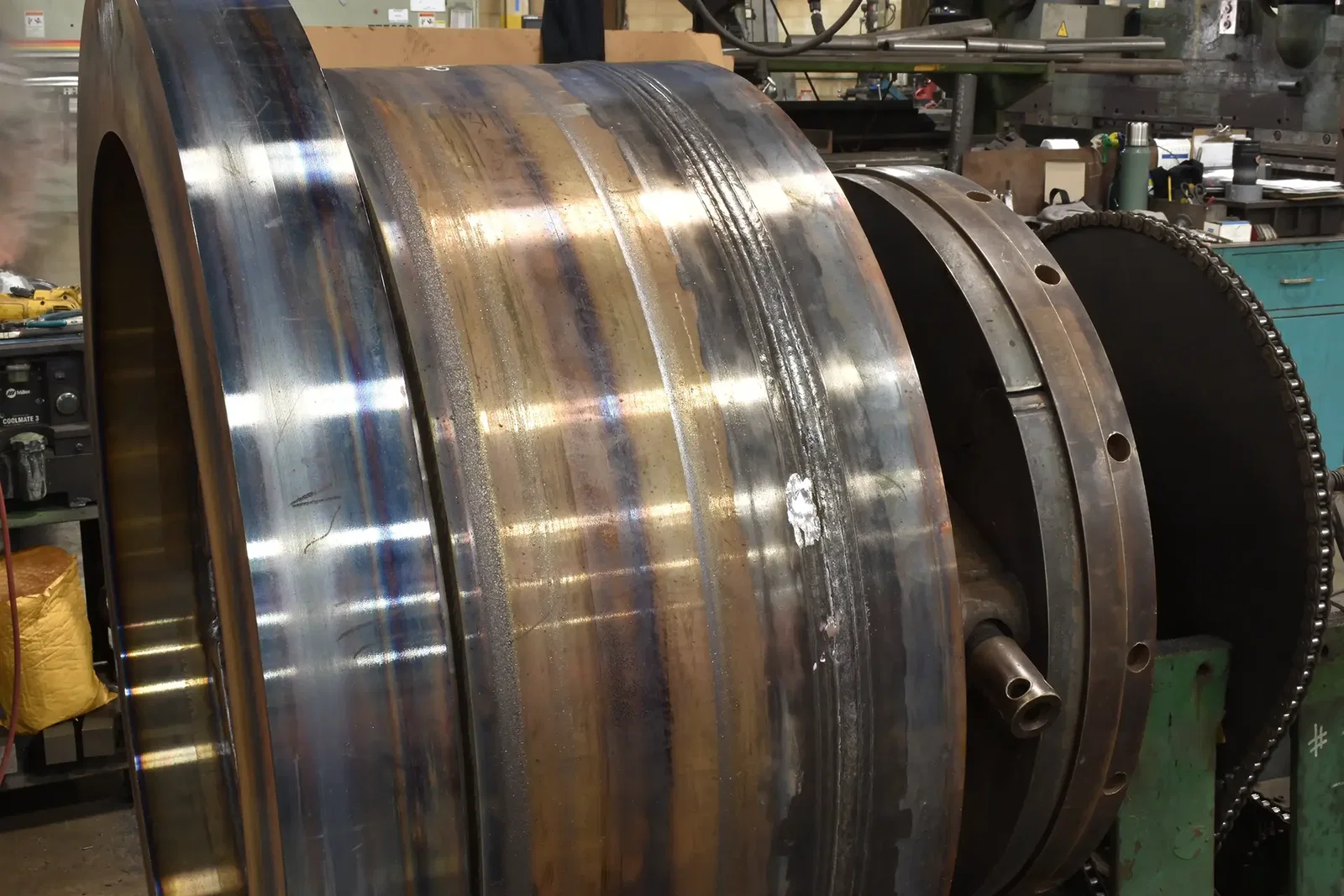
How the Work Comes Together
More than a list of processes.
A fabricated weldment is a sequence, not a set of separate purchases. Every handoff below happens inside one building, which is why the schedule holds and why the tolerance at the end still refers to the part you drew.
-
01
Cut
Plate and sheet cut on fiber laser, plasma, oxy-fuel flame, shear or saw — the process chosen by thickness, edge quality and volume rather than by what happens to be free.
-
02
Form
Press brake forming to 750 tons and 20 feet, plate rolling and bump forming. Parts most fabricators send out are formed here, so the schedule never leaves our control.
-
03
Fit & weld
Fixtured and tacked to hold datum, then welded to AWS and ASME procedures with the weld sequence planned to balance heat input and control distortion across the structure.
-
04
Machine
Mounting faces and critical bores machined after welding, so final tolerances account for weld movement instead of fighting it.
-
05
Assemble & finish
Mechanical assembly to 20,000 lb, then sandblasting, paint, powder coat, plating or galvanizing — so what ships is a finished unit, not a box of parts.
Welding
Weld Control on Large Structures
MIG, TIG, stick and flux-cored welding to AWS and ASME procedures, with a Certified Welding Inspector on staff. Robotic cells for repeat production, manual stations for one-offs and large weldments, and 10-ton overhead crane coverage for the pieces that need it.
| Capability | Detail |
|---|---|
| Qualification | AWS and ASME procedures, Certified Welding Inspector (CWI) on staff |
| Processes | MIG (GMAW), TIG (GTAW), stick (SMAW), flux-cored (FCAW) |
| Weldment capacity | To 20,000 lb |
| Max part length | 60 ft |
| Overhead crane | 10 ton |
| Materials | Carbon, stainless, aluminum, high-alloy and nickel-based alloys |
Robotic Welding
A Panasonic robot on a PerformArc system with Miller Electric MIG, running an A/B split station so one side loads while the other welds. Handling stations rated to 1,100 lb.
Weld Types & Joint Design
Five weld joint types and thirteen weld types, with guidance on which suits which application and why.
Forming
Press Brake Forming to 750 Tons and 20 Feet
Press brake forming, plate rolling and bump forming for large radii — the capacity to form parts most fabricators have to send out, on the same floor as the welding that follows.
| Capacity | Bed length |
|---|---|
| 750 ton | 20 ft |
| 400 ton | 12 ft |
| Spec | Value |
|---|---|
| Rolling width | 6 ft 2 in (74 in) |
| Max thickness | 7/16 in |
Bump Forming
Large-radius forming on the press brakes, for curves beyond the thickness range of the plate roll.
Press Brake Forming
Tooling, bend allowances and the forming sequence behind the capacity figures above.
Cutting
Plate Processing to 6 Inches
Five cutting processes in house, from a 20 kW fiber laser for precision sheet and plate up to oxy-fuel flame cutting at 6 inches. Because all five are on the same floor, the choice is made on what the part needs — thickness, tolerance, edge quality, volume — rather than on what the shop happens to own.
Oxy-Fuel Flame Cutting
Two oxy-fuel torches on an 11 ft × 28 ft table, cutting steel to 6 inches thick — the heaviest plate capacity in the shop.
High-Definition Plasma
400-amp CNC plasma with beveling, producing V, A, X, K and Y bevels as part of the cut rather than as a secondary operation.
20 kW Fiber Laser
A 60 in × 144 in bed cutting carbon steel to 1.25 in, stainless to 0.5 in and aluminum to 0.375 in — clean edges and tight tolerances straight off the table.
Shearing & Production Sawing
Shearing to 0.25 in × 10 ft, plus production sawing — cold saw and miter — for structural shapes and bar stock.
| Process | Capacity | Notes |
|---|---|---|
| Oxy-fuel flame | 6 in steel | 2 torches, 11 ft × 28 ft table |
| Plasma | 400 amp | Bevel types V, A, X, K, Y |
| Fiber laser | 20 kW | 60 in × 144 in bed; carbon 1.25 in, stainless 0.5 in, aluminum 0.375 in |
| Shearing | 0.25 in × 10 ft | — |
| Production sawing | Cold and miter | Structural shapes and bar stock |
Machining
On-Site CNC Machining
When a fabricated structure needs a precision bore or a flat mounting face, doing it here keeps the tolerance referenced to the weldment itself rather than to a second setup at another shop.
Haas Vertical Machining Centers
Haas TM-2P and Haas VF-6/50, with work envelopes handling pieces to 4,000 lb. Full travels, table sizes, spindle speeds, tapers and tool-changer capacities are listed on the machining page.
Boring, Drilling & Milling
Machined surfaces, precision bores and drilled patterns on fabricated assemblies, sequenced after welding so final tolerances account for weld movement.
Assembly & Finishing
Shipped as a Finished Unit
Mechanical assembly, sub-assembly and finished-goods build to 20,000 lb, so what leaves the dock is a completed unit rather than a box of parts.
Mechanical Assembly
Sub-assembly and full build to 20,000 lb, completed in-house, including hardware, fitting and functional components.
Finishing
We offer sandblasting, painting, powder coating, plating and galvanizing, so equipment leaves ready for the field.
Quality Inspection
ISO 9001:2015 certified, with the quality system documented through every operation and CWI inspection on welded work.
Materials
Materials We Process
Plate, sheet, bar and structural shapes, sourced to the grade and certification the job calls for.
Grades, specifications and certification detail at our Materials List.
Markets We Serve
Where These Capabilities Go to Work
Four markets where large fabricated weldments, tight timelines and difficult execution are the norm rather than the exception.
Heavy Equipment & Mining
Structural weldments and wear components built to survive abrasive, high-load service.
Power Generation & Energy
Enclosures, bases and frames for generation and energy infrastructure programs.
Civil Infrastructure & Water Control
Gates, liners and water-control structures fabricated to civil specifications.
Bulk Material Handling
Conveyor structures, hoppers and transfer equipment for continuous material systems.
Proof
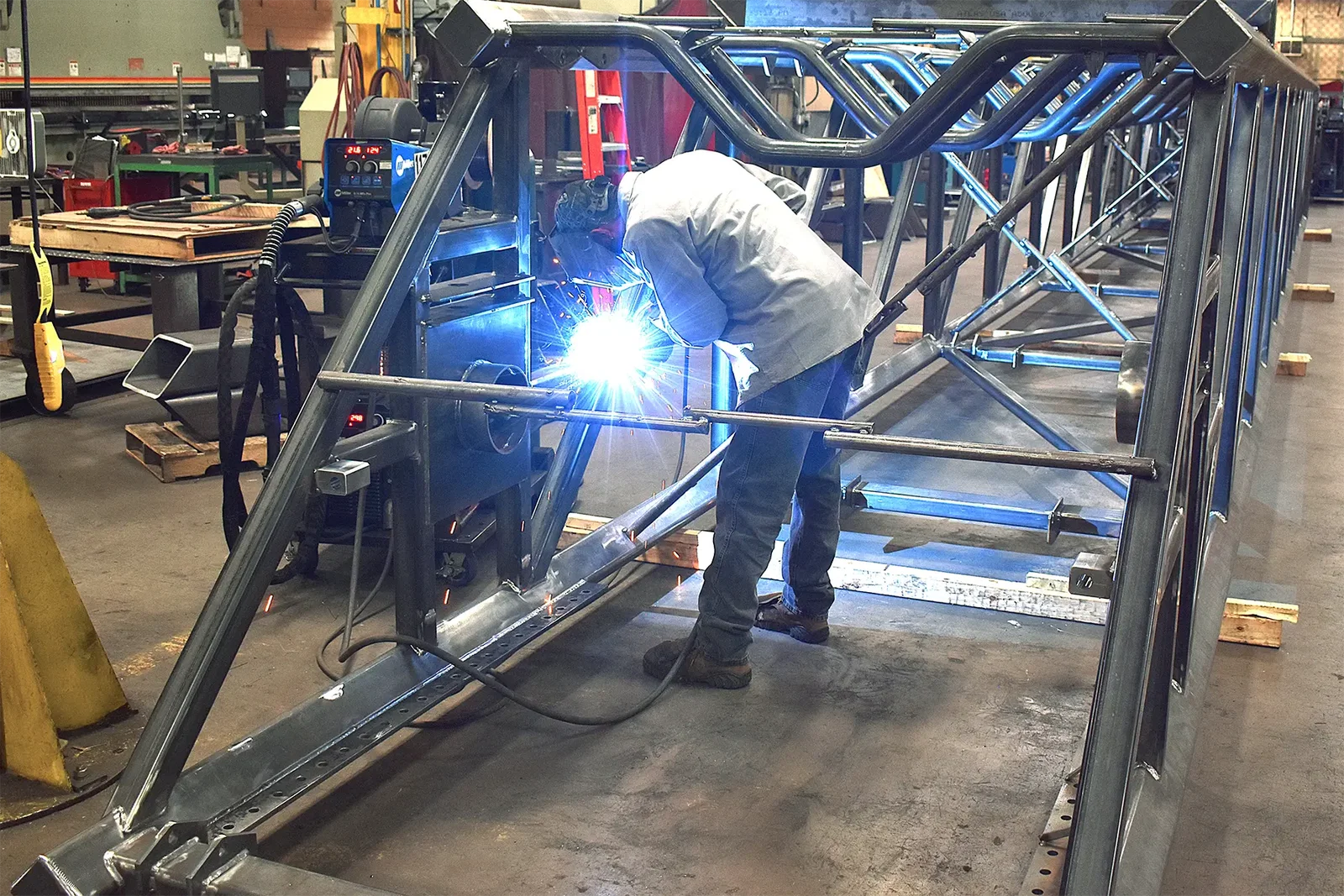
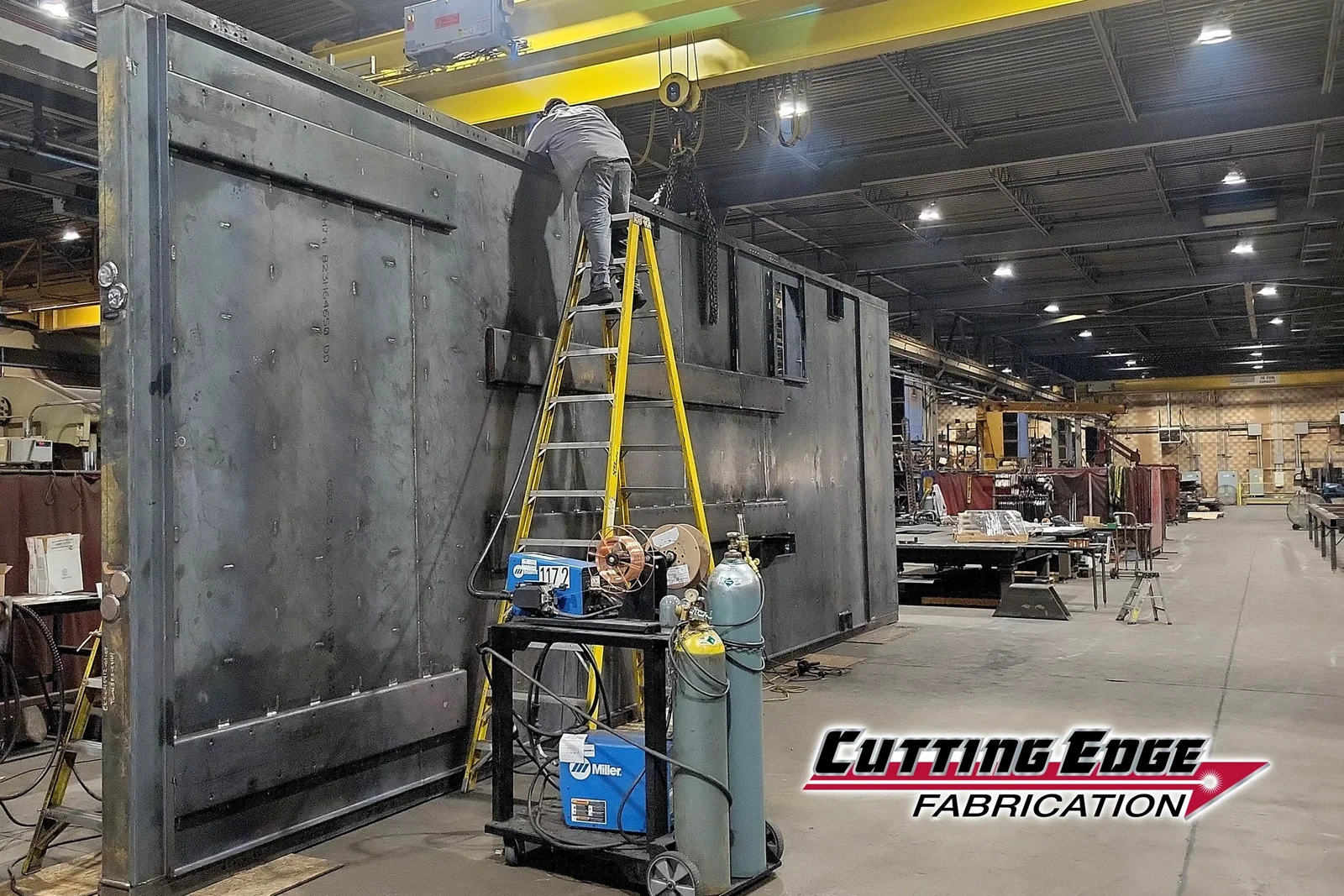
Metal Fabrication Capabilities on Real Jobs
Fabrication work from our shop floor, with the processes and scale each job actually required.
Why CEF
Built for the Jobs That Are Hard to Execute
Our metal fabrication capabilities are built around medium to large parts and mechanical assemblies where cutting, forming, welding, machining and finishing all have to come together on one program — and where the schedule is tight or the work is difficult enough that control and responsiveness matter more than unit price.
- ISO 9001:2015 certified — quality system documented through every operation
- AWS and ASME welding procedures with a Certified Welding Inspector on staff
- Press brake forming to 750 tons and 20 feet, plus bending, bump forming, and plate rolling on-site
- Laser, plasma, oxy-fuel flame, shearing, production sawing, miter sawing, and cold sawing in-house
- Certified welders across a full range of metals including aluminum, high-alloy steel, and nickel-based alloys
- On-site CNC machining for precision bores, drilled surfaces, and critical tolerances
- Full assembly in-house, with finishing services including sandblasting, painting, powder coating, plating, and galvanizing
- 65,000 square foot facility with overhead crane coverage — weldments to 20,000 lb and lengths to 60 feet
- In business since 1990 — Milwaukee, WI, serving Wisconsin and Northern Illinois
Project Fit
Is CEF the Right Shop for Your Job?
A straight answer here saves everyone a quoting cycle. Where we are strongest, and where we are not.
Where We Fit Best
Medium-to-large carbon steel fabricated weldments and assemblies where we provide the complete fabrication scope — cut, formed, welded, machined, assembled and finished as one program.
We do not require high-volume or highly repetitive work. A significant portion of our business is lower-volume custom fabrication for OEM and industrial customers.
Where We Are Less Competitive
Individual cut or formed components quoted on unit price alone. If you need one operation in isolation and the lowest number wins, a shop built around that single process will usually beat us on price.
Our value shows up when a part takes several operations and somebody has to own the whole thing.
Ready to Work Together
Send Us a Drawing
Send a print, a sketch, or a description of the part. We’ll tell you whether it fits our equipment and what it will take to build.
DXF, DWG, PDF, SolidWorks, STEP — all accepted. Response within one business day.
Common Questions
Frequently Asked Questions About Our Fabrication Capabilities
Questions we hear from engineers and procurement managers scoping a fabrication package.