
Civil Infrastructure and Water Control
150-Foot Telescopic Conveyor Built for Dam and Lock Construction
APPLICATION
Fluid Concrete Placement
EXTENDED LENGTH
150 ft
COMPONENTS
800+ Welded Steel Parts
TOTAL WEIGHT
30,000 lb
What We Built
CEF fabricated a three-rail telescopic conveyor system that extends to 150 feet, built from more than 800 welded steel components at a combined weight of 30,000 pounds. The system mounts on heavy equipment for mobility and extends to transfer fluid concrete in dam and lock system construction.
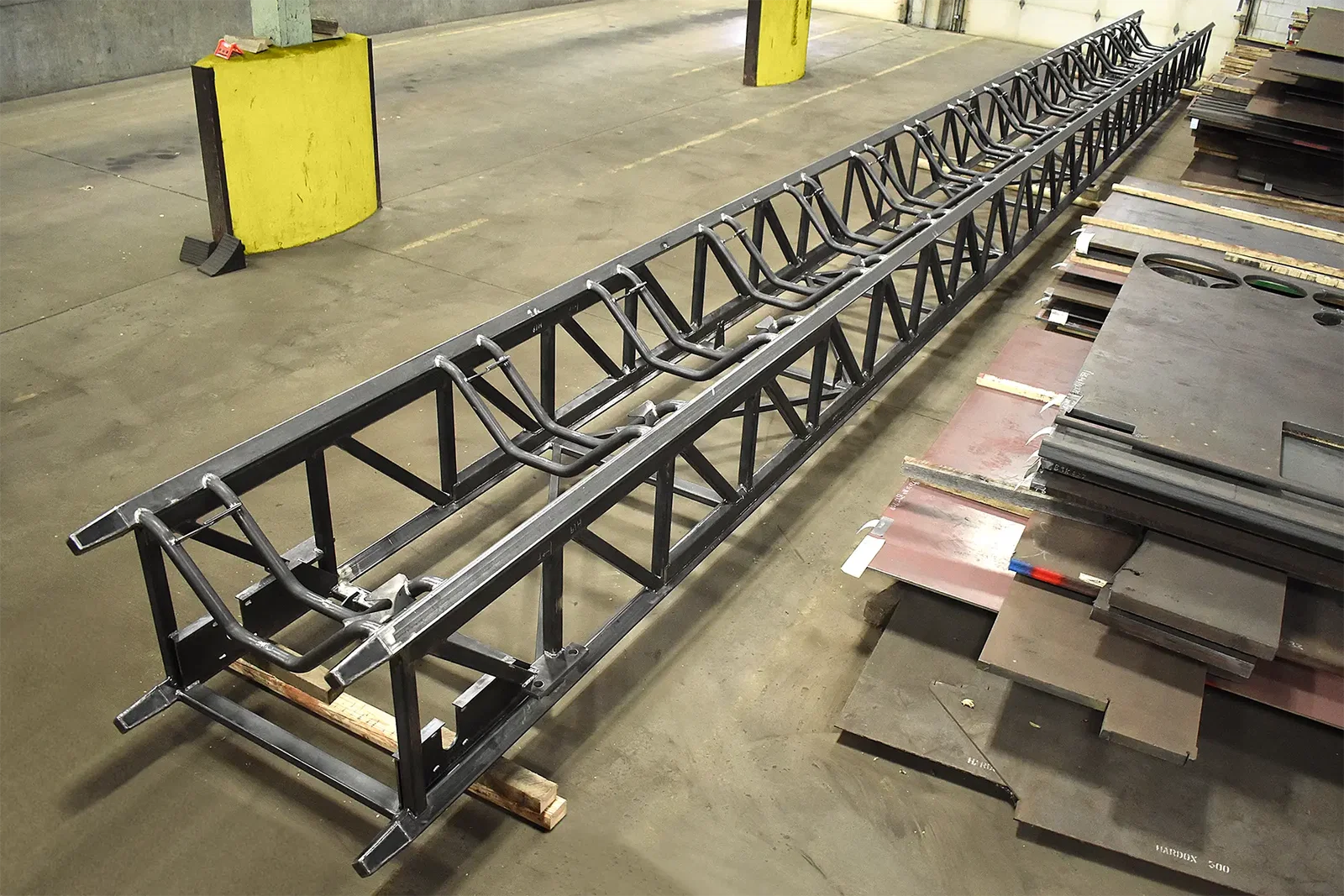
The Challenge
A telescoping conveyor only works if its rails stay true to one another. Three nested rails — the base alone 70 feet long and 13,000 pounds — have to hold their geometry through cutting, fitting, welding and handling, then extend and retract under load with wet concrete moving along them. At that scale the structure has to be repositioned during fabrication, and every move is an opportunity to lose alignment that has already been established.
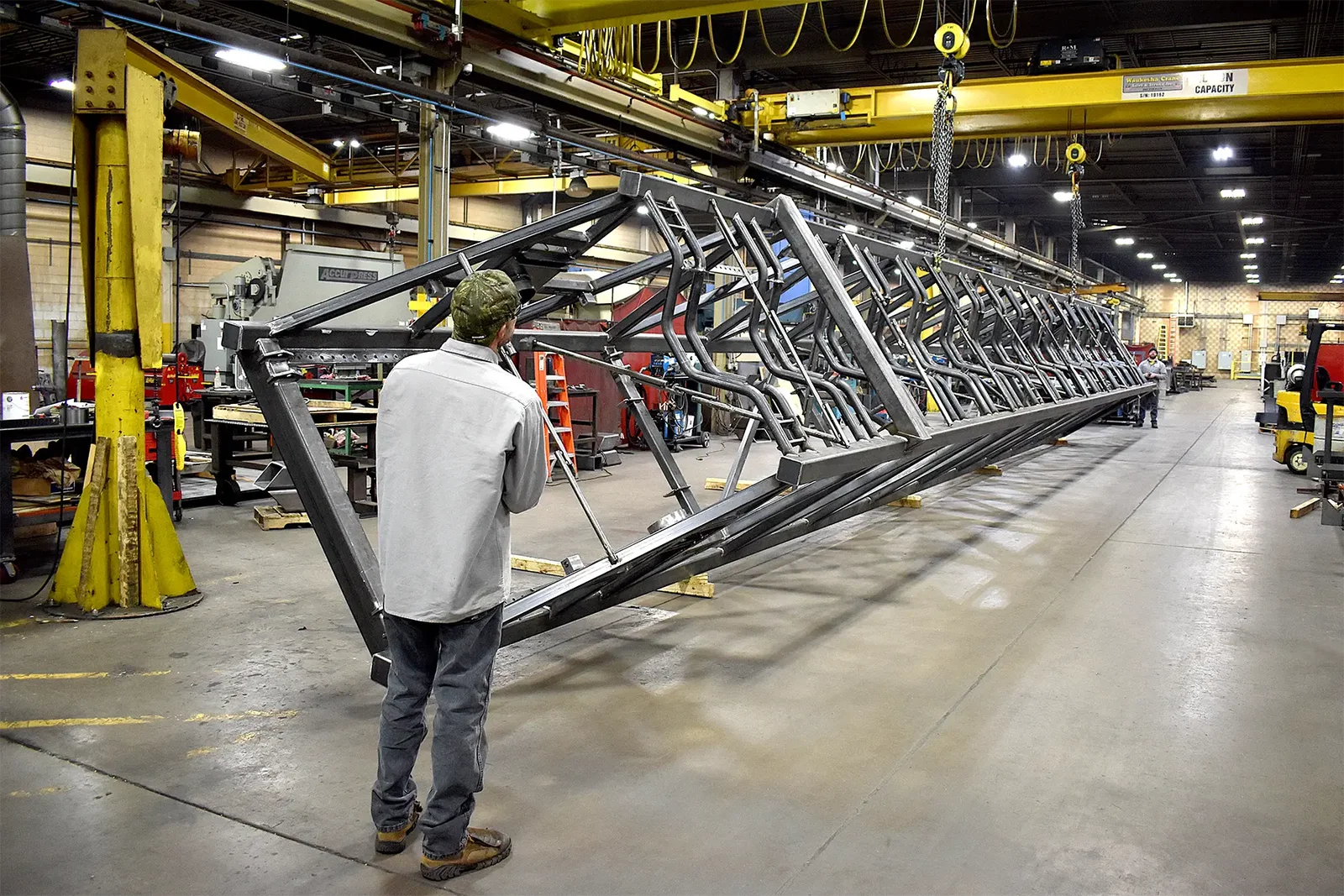
What We Did
Parts were cut by laser and plasma, sawn to length and pipe bent, then precisely fitted and MIG welded from steel tube, pipe, plate and bar. With the 70-foot, 13,000-pound base rail nearly complete, two 10-ton cranes rotated it into an upright position so the final welds could be made in place. Bracing and supports were then removed and all welds cleaned.
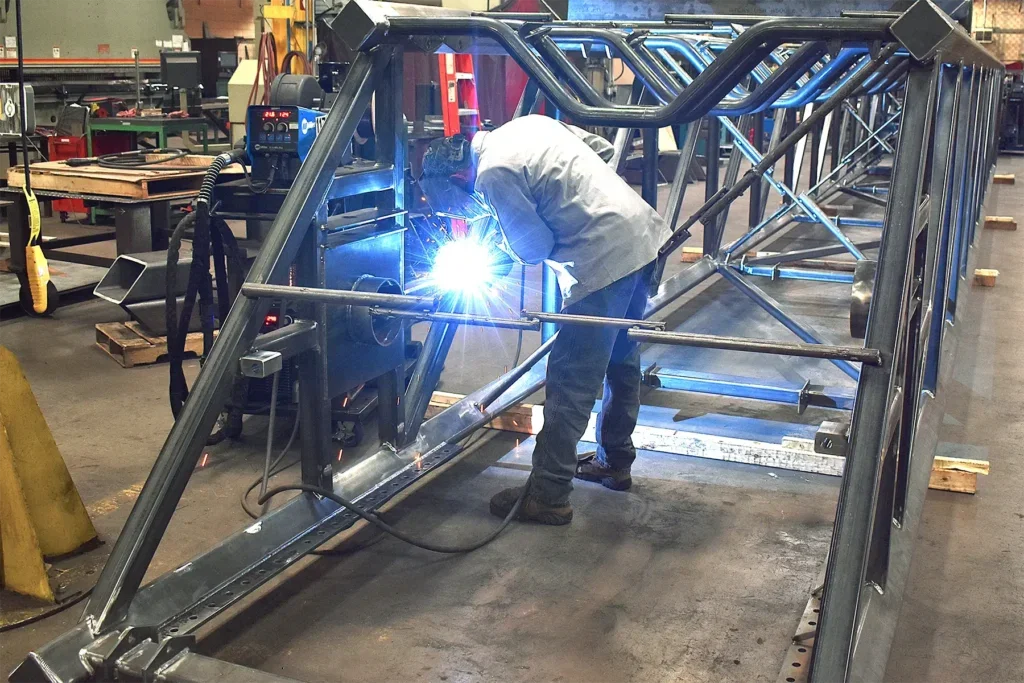
The Result
Quality checks took place at every fabrication phase, followed by a final review of the complete structure. The 3,000-pound inner conveyor rail passed inspection meeting or surpassing all design specifications, and moved to the shipping area for delivery.
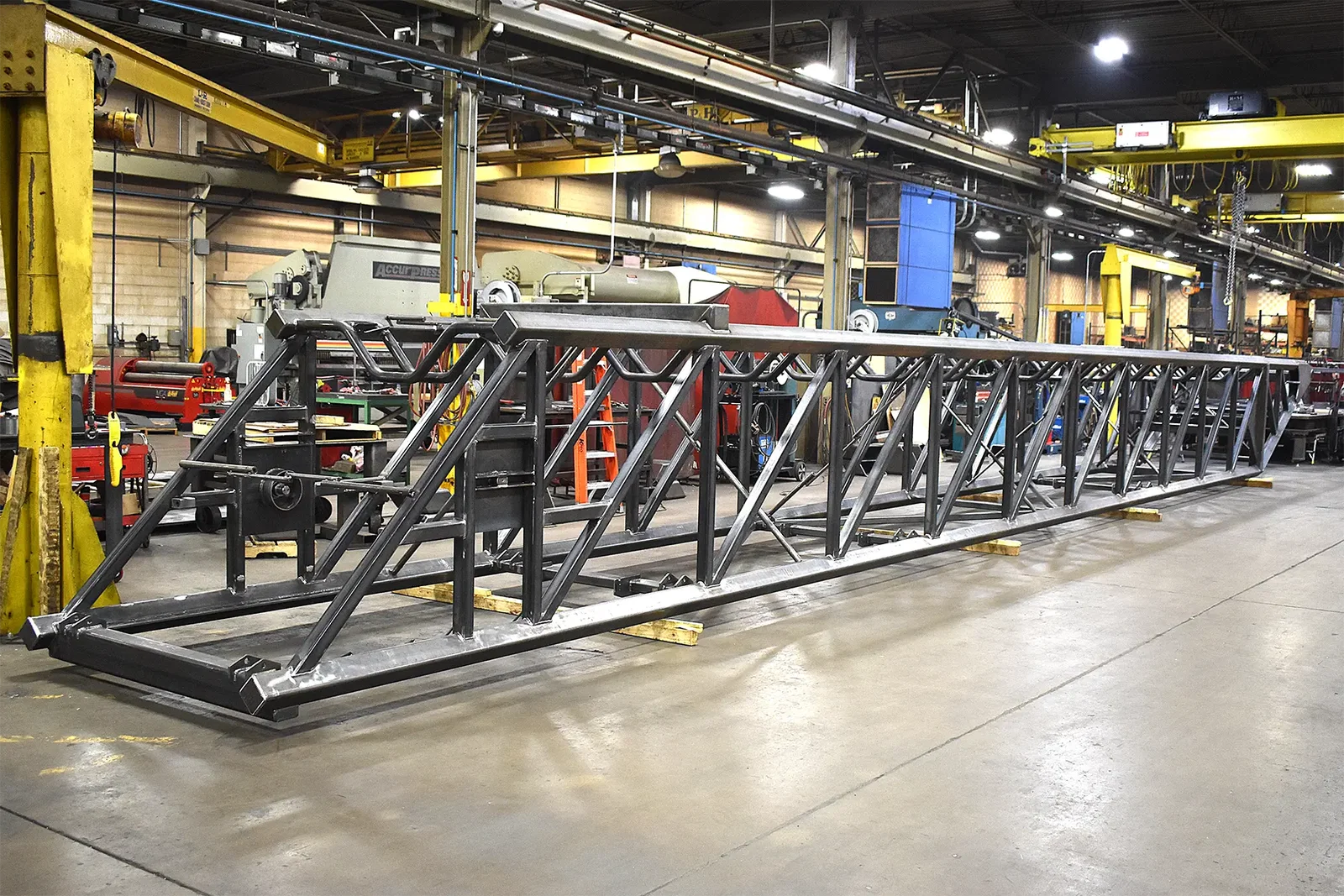
Engineering Considerations for Long Telescoping Structures
Length is what makes a telescoping structure difficult. Welding shrinks steel along the weld, and the published figure for longitudinal shrinkage is roughly one millimetre for every three metres of weld — about 0.04 inch per 10 feet. On a short assembly that disappears into normal tolerance. On a rail measured in tens of feet, with weld running most of its length, it becomes a dimension that has to be planned for rather than discovered.
Fabricators compensate in one of two ways: build the member over-length and trim it after welding, or add a calculated shrinkage allowance before the first pass. Both are decisions made before fabrication starts. Neither is available once the structure is welded.
Distortion does not begin at the weld, either. Thermal cutting releases the residual stresses locked into rolled plate, and a strip cut from a larger sheet can curve before it is ever welded. Asymmetric sections compound the effect, because shrinkage pulls unevenly about the neutral axis and the member bows toward the heavier side of the joint. Planning to avoid distortion is consistently cheaper than correcting it afterward.
A nested assembly raises the stakes because its tolerances are relational rather than absolute. A single rail can be within tolerance on its own and still bind against the rail it has to slide through. What matters is the relationship between sections across the full travel — which means the geometry that counts is only fully verifiable once the sections are assembled, not when each is inspected on its own.
For a buyer, the useful question to ask about a long or telescoping structure is not whether a fabricator can hold a tolerance, but when and how they intend to check it. Geometry caught during fabrication is adjustable. Geometry discovered at assembly is rework.
Related: Civil Infrastructure & Water Control · Bulk Material Handling · Large Welded Structures
- Primary challengeAlignment across three nested rails
- Scale handled70 ft, 13,000 lb base rail
- Key operationsCutting, pipe bending, MIG welding
- InspectionVerified at every phase
Have a Similar Project?
Send us your drawing and we’ll tell you what it takes to build it.
Submit a DrawingLarge Weldments, Built to Your Drawing
CEF fabricates medium-to-large welded structures and mechanical assemblies for power generation, heavy equipment, civil infrastructure, and material handling.